Can crown caps be fed automatically?
Yes. Crown caps are a common feeding application when the feeder is matched to the capper and output requirement.
Industry route
Crown cap feeding and sorting systems for beverage packaging lines that need reliable closure presentation.
Specification focus
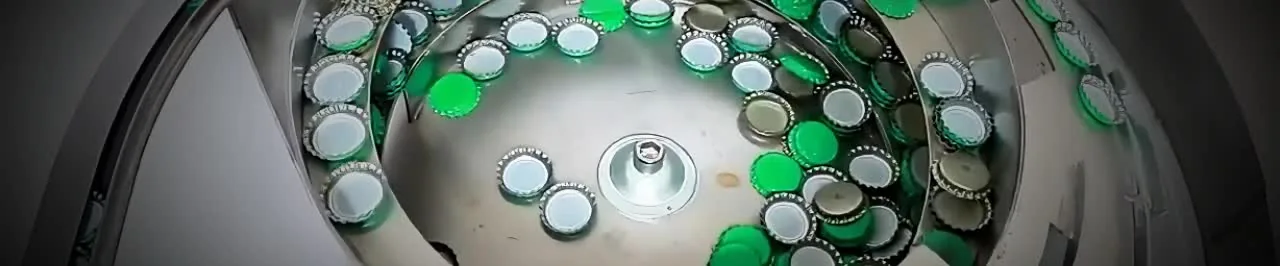
Beverage lines need caps presented consistently to avoid capping interruptions. Crown caps can be fed and orientated using tooling designed around cap diameter, skirt geometry and the receiving capping equipment.
Tooling is planned around cap profile and required presentation into the capper.
Feed rate, queue length and capper demand must be checked against production output.
Chutes, hoppers and sensors can be matched to the beverage line layout.
Planning details
These points help Lancing UK narrow the feeder route and avoid a generic specification.
| Area | What matters |
|---|---|
| Suitable closures | Crown caps and similar metal closures for bottle capping lines. |
| Important details | Cap samples, capper type, target bottles per minute and discharge height. |
| Common options | Bowl feeder, hopper, chute, sensor, linear track and custom stand. |
| Project aim | Keep the capping stage supplied without caps jamming or arriving in the wrong orientation. |
Quick answers
Yes. Crown caps are a common feeding application when the feeder is matched to the capper and output requirement.
Send crown cap samples, bottle and capper details, target speed and photos of the line layout.
A hopper can often be added to reduce manual topping-up and maintain a steadier cap supply.
Use these pages to compare related feeder options and prepare a stronger quote request.
Send samples, photos, required orientation and target output to Lancing UK.
Industry specification
This page should help buyers describe the feeding problem clearly while keeping complete packaging-line, filling or capping decisions on the right Lancing routes.
The bowl feeder owns crown cap orientation, chute transfer, capping demand and bottle-line integration. It should not be treated as a generic machine purchase without the part samples and downstream interface.
Component feeding systemsSend samples, part dimensions, target rate, required orientation, discharge height, line layout, available footprint and utility/control requirements.
Enquiry checklistAvoid assuming a feeder will handle every future format. Different caps, pumps, closures or small parts can need different tooling, rails or discharge parts.
Changeover guide| Industry constraint | Feeder design response |
|---|---|
| Noise and operator access | Consider acoustic covers, realistic bowl speed, refill height and safe access to clean or clear the track. |
| Static, coating and marking | Discuss plastic behaviour, surface finish, part marking risk and whether lining or special contact surfaces are required. |
| Cleanliness and washdown expectations | State any hygiene, cleaning or environment expectations so unsupported cleanroom or food-grade assumptions are not made. |
| Jam detection and controls | Confirm the sensor, full-track, low-level and PLC-interface expectations for the line. |