Cap feeding for bottle lines
Feeds screw caps into automatic cappers, including orientation checks and discharge into the cap chute.
Applications
Use this page to match common components with the right bowl feeder, cap feeder or orientation route.
Feeds screw caps into automatic cappers, including orientation checks and discharge into the cap chute.
Supports more complex closures where orientation and handling must be assessed carefully.
Closure handling route for beverage lines where caps need reliable presentation to the capper.
Feeding and counting support where product flow and gentle handling are central to the brief.
Sorting and feeding small repeatable components to assembly or pick-and-place fixtures.
Retrofitting a feeder to reduce manual loading, smooth output or improve capping consistency.
Practical planning
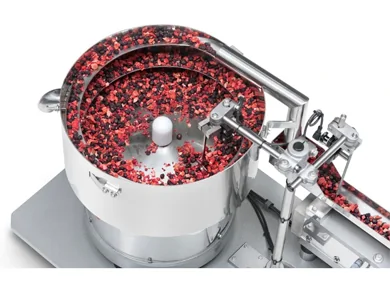
The best feeder route is shaped by how the component behaves in bulk. Symmetry, weight, ribs, surface finish and centre of gravity all affect how it can be oriented.
Use these pages when your search is about the problem the feeder needs to solve.
Send photos or samples. Lancing UK can advise on feasibility and the right configuration route.
Explore feeding applications
Compare closure feeders, screw-cap orientation, feeder tooling and contract-packing applications to identify the configuration needed for your parts and production line.
Buyer guidance
Application pages should narrow the orientation problem before a final feeder product is selected.
For caps and closures, confirm open side, thread direction, capper infeed height, hopper need and whether a capper signal is available.
Cap sorting and orientationFor assembly or pick-and-place, confirm pick face, escape position, sensor confirmation and whether a linear or bowl route is better.
Component presentationFor pumps, triggers and sprayers, provide samples so tangling, balance and presentation limits can be checked early.
Pump and sprayer feeding| Detail to confirm | Why Lancing needs it |
|---|---|
| Component geometry and material | The tooling, track and reject method depend on the actual cap, closure or part rather than the name of the application. |
| Required orientation and discharge height | The feeder must deliver the part in the correct attitude and at the correct mechanical interface point. |
| Target feed rate and line interface | The bowl, hopper, controller and sensors must be matched to the downstream process without over-feeding or starving it. |
| Noise, static, coating and cleaning needs | These constraints influence lining, covers, sensor selection, tooling access and maintenance planning. |
Use these guides to compare feeding technologies, prepare trials, plan installation and define the control interface before quotation.
Application planning
The component is only one part of the application. The receiving process, demand pattern and operating environment also determine the correct feeder route.
The accepted orientation may be the same, but discharge height, approach direction, available footprint, accumulation, release timing, sensor location and control signals can differ. A feeder designed for one capper or assembly fixture should not be assumed to transfer directly to another without checking the complete handover.
After orientation, the system still has to maintain spacing, prevent overlap, carry the part to the correct datum, detect availability and release it at the right time. These downstream details often determine whether the project needs a linear track, chute, escapement, nest or additional sensor.
Bulk loading should maintain a suitable quantity in the bowl without overfilling it. Downstream release control should respond to the receiving machine and the oriented queue. Separate sensors and logic may be needed because a full hopper does not show whether a correctly oriented part is ready at the handover.
Agree the sample set, required orientation, test demand, acceptable reject behaviour, handover position, sensor states and the conditions under which output will be observed. Clear acceptance evidence avoids judging the feeder only by an unloaded demonstration or a short run of ideal parts.
Plastic moulded parts, clips and lightweight components can require different checks from caps or metal fasteners, especially around static, flash, marking and acceptable orientation.
For clips, caps, housings and moulded parts where production samples are essential before confirming tooling.
Open plastic part guidanceFor parts where singulation and presentation matter more than closure handling.
Review small component orientationFor applications that need a repeated pick face, pitch or escapement for robot or fixture handover.
Review pick-and-place presentation