Can flip-top caps be fed closed?
Often yes, but the closure state must be confirmed because open or partly open caps can feed differently.
Application
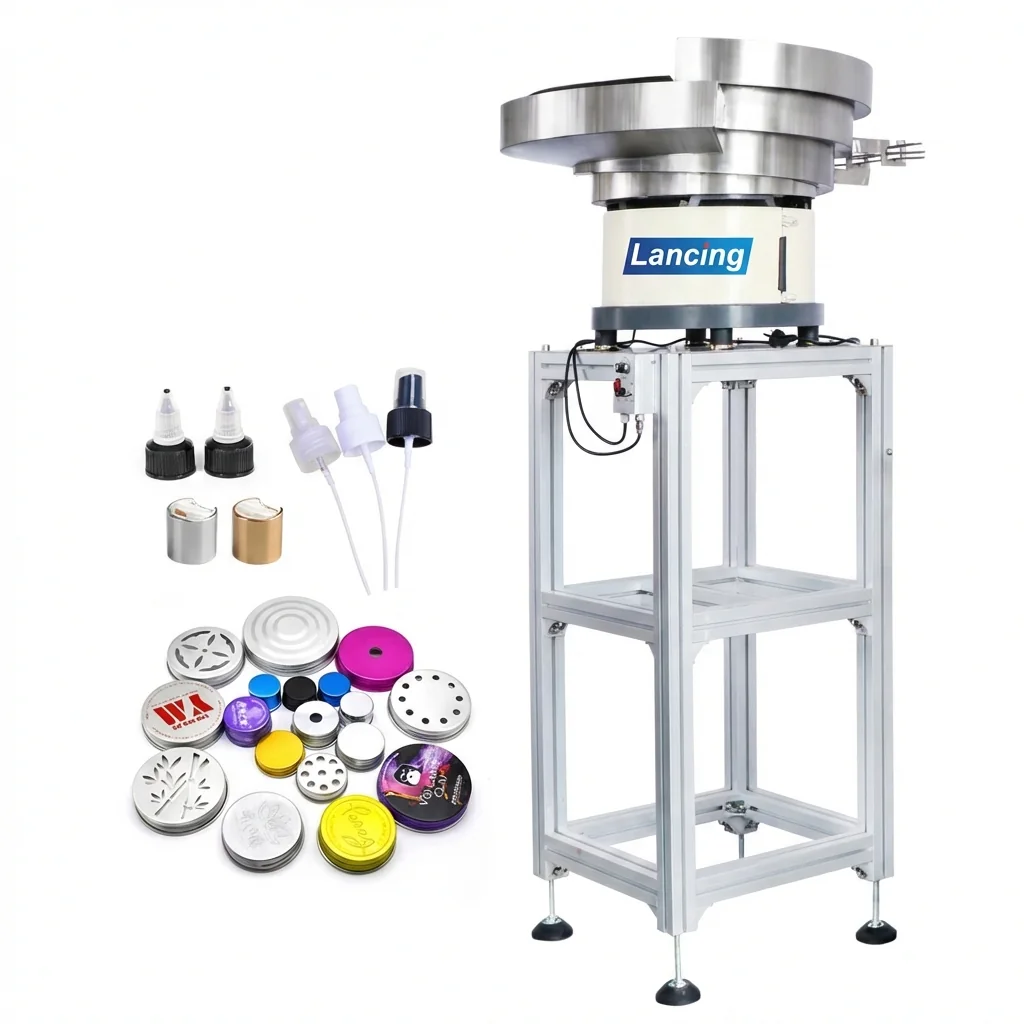
Feeding and orientation systems for hinged flip-top caps and dispensing closures used on bottle lines.
Specification focus
Flip-top caps need careful assessment because the hinge, lid position and overall balance can influence how the closure sits in the bowl. The feeding route should protect the hinge while delivering the required presentation to the capper.
The hinge can be used as an orientation feature but must not be damaged during feeding.
Suitable for personal care, food, household and contract packing cap-feeding projects.
The feeder outlet is planned around cap placement and capping requirements.
Planning details
These points help Lancing UK narrow the feeder route and avoid a generic specification.
| Area | What matters |
|---|---|
| Typical caps | Flip-top caps, hinged caps, dispensing closures and snap closures. |
| Key checks | Hinge position, open/closed state, thread, height, diameter and required orientation. |
| Output factors | Cap size, shape stability, track design, hopper behaviour and capper demand. |
| Options | Hopper, acoustic cover, sensor, chute, reject tooling and custom stand. |
Quick answers
Often yes, but the closure state must be confirmed because open or partly open caps can feed differently.
Yes, the hinge can help identify orientation, but tooling must be designed to avoid damage.
Send production caps in the intended delivered state, plus bottles and capper details if available.
Use these pages to compare related feeder options and prepare a stronger quote request.
Send samples, photos, required orientation and target output to Lancing UK.
Application detail
This application is owned by the feeding and orientation problem: the component must arrive at the next machine in the right attitude, at the right height and under control.
Confirm hinge direction, lid position, cap height variation, reject logic and changeover requirements. Photographs help, but real samples are normally the deciding evidence for tooling and orientation.
Sample requirementsThe application may need a bowl, linear track, hopper, chute, escapement, sensor or a combination of these parts rather than a single generic machine.
Product routesWhere the main buying decision is the capping machine or wider packaging line, keep this site focused on feeding and use the broader Lancing machinery routes for the rest of the line.
Lancing capping machinery| Application risk | What to check before quoting |
|---|---|
| Wrong orientation | Define the acceptable exit attitude and the reject/recirculation approach for parts that do not present correctly. |
| Jam or bridge points | Review track loading, part nesting, cap edge detail, static and the handover into the chute or pick point. |
| Output mismatch | Agree whether the feeder must buffer, stop/start or be controlled by the downstream machine. |
| Change-part limits | List every part family expected to run so tooling and changeover can be scoped without unsupported assumptions. |