Sample review
Assess size, finish, material and consistency.
Bowl feeder selection
Reliable sorting and presentation for repeat parts used in assembly, packaging and automation.
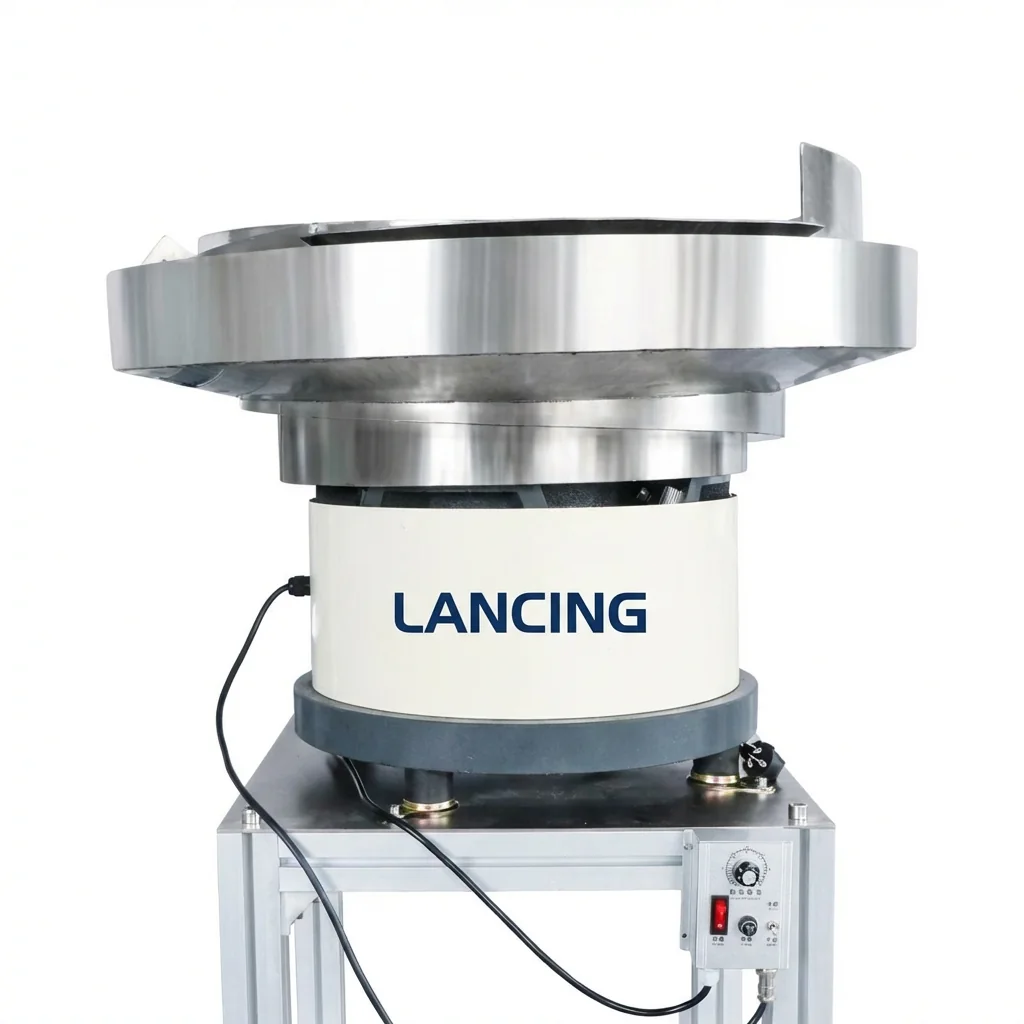
Small component orientation systems are used where loose parts need to be sorted and presented in a controlled way before the next process. This can support assembly cells, inspection stations, counting operations, packing machines and bespoke automation projects.
The right route may be a vibratory bowl feeder, linear track, escapement, sensor-controlled discharge, hopper feed or a combined system. Lancing UK can help define the practical route around the part, the production target and the downstream process.
Assess size, finish, material and consistency.
Define the acceptable final position.
Match the discharge to the machine after it.
Add sensors and stop/start logic where needed.
Bespoke feeding
A feeder is normally designed around the specific component. Parts that look easy to feed can still cause problems if they are light, flexible, sticky, symmetrical or prone to nesting.
Sending samples early gives the best chance of identifying the correct feeder route before a full quotation is issued.
Send the part details and required orientation for practical advice.
Application detail
This application is owned by the feeding and orientation problem: the component must arrive at the next machine in the right attitude, at the right height and under control.
Confirm part symmetry, centre of gravity, tooling features, escape/reject route and pick-point access. Photographs help, but real samples are normally the deciding evidence for tooling and orientation.
Sample requirementsThe application may need a bowl, linear track, hopper, chute, escapement, sensor or a combination of these parts rather than a single generic machine.
Product routesWhere the main buying decision is the capping machine or wider packaging line, keep this site focused on feeding and use the broader Lancing machinery routes for the rest of the line.
Lancing capping machinery| Application risk | What to check before quoting |
|---|---|
| Wrong orientation | Define the acceptable exit attitude and the reject/recirculation approach for parts that do not present correctly. |
| Jam or bridge points | Review track loading, part nesting, cap edge detail, static and the handover into the chute or pick point. |
| Output mismatch | Agree whether the feeder must buffer, stop/start or be controlled by the downstream machine. |
| Change-part limits | List every part family expected to run so tooling and changeover can be scoped without unsupported assumptions. |